 Subscribe to our RSS feed
 Find us on Facebook
 Follow us on Twitter
When the relationship between a landlord and a tenant breaks down, and the Landlord Tenant Board has issued an eviction order, what comes next?
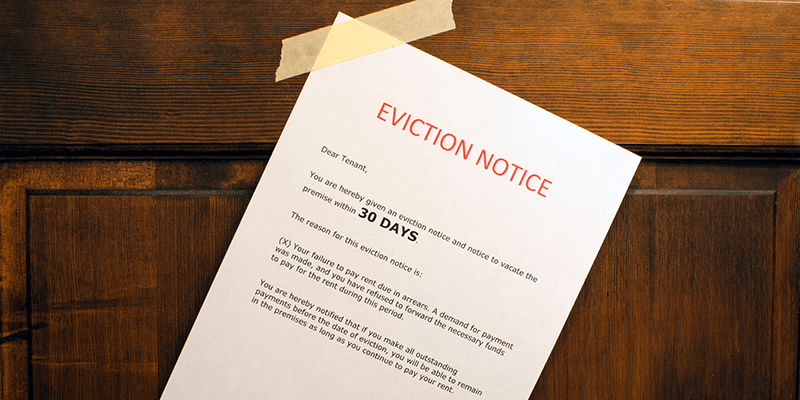
An example of an eviction notice pinned to a door. Credit: GTA Landlord
If you’ve ever received an order from the Landlord and Tenant Board (the LTB), you know that it feels like finally crossing the finish line after a long, drawn-out race; except, the race isn’t quite over yet. Once you’ve received the order setting out that your tenant owes rent and must move out, there’s a lingering question – what now?
Enforcing an LTB order: Evictions and possession – Time to call the Sheriff
The golden rule of evictions is that you’re not enforcing an order, rather, the Sheriff and its office have a duty to do so. For example, changing locks, moving belongings to the street, or any other do-it-yourself eviction will award you with an illegal lockout claim, which come with serious consequences. When the termination date listed in your order passes and the unit isn’t voluntarily vacated, you could file a copy of the LTB order, an Eviction Information Requirements Form, and payment for the enforcement fee for the Sheriff’s office which covers your property’s area. The Sheriff’s timeline for scheduling an enforcement varies by region and typically the Sheriff issues a “Eviction Instructions” which generally sets out their estimate. Moreover, the Sheriff will notify the Tenant of the pending enforcement and confirm the specific date and time usually within 48 hours of the eviction. It’s important that when you know the exact enforcement date and time, that a locksmith is present to secure the unit.
Tenants have 72 hours from the time of eviction to make arrangements with the landlord to collect any remaining belongings in the Unit.
Collecting money owed under the order: When “pay up” needs real teeth
Portions of an order relating to money (ex. arrears and costs) are binding, but they don’t magically appear in your bank account. The exception is voluntary payment. If a tenant ignores required payments, the next practical step is to transfer the order to the Small Claims Court (the SCC). The SCC could provide a landlord with collection tools such as wage garnishment, seizure of assets, or a writ of seizure and sale. These tools come with paperwork, fees and time and realistically, recovery can take months or even longer.
Receiving an LTB order is progress, but it’s not the finish line.
